Monday, November 13, 2023

From the Desk of Jim R, Take 2, Column 438, A Review: "Elf - the Musical" (Fairfield Center Stage)

 By James V. Ruocco 

"Christmas is a lot more than just Santa Claus. Christmas is sleeping on a futon. Having cold spaghetti for breakfast with your little brother. It's going ice skating with your girlfriend and kissing her for the very first time under a big, glittery Christmas tree.
"It's traveling miles and miles to be with your family, walking through the Lincoln tunnel with cars blowing their horns the whole time and drivers yelling things that no person should say to another human being, let alone to an elf.
"It's hoping that when you wake up on Christmas morning, all the cars, and all the big grey office buildings, and all the piles of garbage will be covered in snow."
(Buddy) ("Elf - the Musical") 

If you've seen the 2003 Will Ferrell film "Elf" ("Is there anyone out there who hasn't?"), you already know the plot.
If you haven't (shame on you), it's time for a recap.
After crawling into Santa's great big sack of presents as a baby, little Buddy is magically transported to the North Pole and raised by those around him as an elf. Years later, he accidentally learns that he's not an elf at all, but rather a very tall human being whose father is a hard-nosed New York publisher of children's books who's about to get the ax unless he comes up with a great holiday story by Christmas Eve.
Not to worry, though.
Traveling to the Big Apple, Buddy is not only reunited with his long-lost family (dad, stepmom and stepbrother), but finds true love with a Macy's department store salesgirl named Jovie, marries her and brings their newborn daughter Suzie back to the North Pole to meet the big man in red.


Drawing its inspiration from the popular Christmas movie, "Elf - the Musical" takes a similar path to Santa Land with storytelling techniques and ideas that recreate most of the amusing diversions of the original film alongside characters, dialogue, musical numbers and dances that replay Buddy's antics with charm, gusto and festive effervescence.
That intoxicating spirit, accompanied by a sparkly presentation of Christmas snap, goodwill and wrapping paper transport, turn Fairfield Center Stage's reenactment of Buddy the Elf's story into a joyful, five-star celebration that hits a high note at every single turn.
This is a grown-up fairy tale of sorts that dares you to dream with lots and lots of candy canes, hot cocoa and candy corn on standby to share with all the people you love.
It pops.
It blazes.
It tilts.
It also bursts into widescreen technicolor glory with astonishing feats of wizardry, niceness and holiday glee that is great fun for all, diced and spliced with Christmas cracker pep and step, twirling satirisation and jolly good sentimentality.

Staging "Elf - the Musical," director Marcelle Morrisey brightens the stage with a viable thrill and spill, offset by great warmth, wonderment, feel-good Christmas magic and shed-a-tear playfulness. Never once losing focus on the intent, purpose and story arc of this popular holiday tale, she fuels the musical with non-stop energy, opportunity and emotion that ditches the schmaltz and overkill of other "Elf" productions in favor of a win-win theatrical experience for all ages that is portrayed with relatable love, originality, style and word-for-word confidence and exhilaration.
Directorially, she has great fun with the material, clarifying the zigzagging, whimsical plot with comfort, zest and shine, mixed seamlessly with candy-cane sweetness, easy-listening sensibility and bang-on detail, encounter and concern. It's all paced and bandied about with fast-moving scene changes, straightforward, immersive storytelling, rippling flutter and landmark negotiation and leverage. Nothing is out of place. Nothing is thrown in for sentiment's sake. It all works splendidly including the snow machines that produce wet, falling whiteness much to the delight of the sugar-crazed, excited kids in the audience.

Full to the brim with Christmas spirit and holiday cheer, "Elf - the Musical" comes gift wrapped with a candy-coated musical score of festive treats, a melee of solo turns and ensemble numbers and joyfully bittersweet melodies that are plum pudding perfect for the snap-bang-wallop holiday fantasia invoked and marketed throughout the two-act musical.
Written by Matthew Skylar (music) and Chad Beguelin (lyrics), the production contains sixteen efficient, clever, strategically placed musical numbers that propel the action forward with lift, reference, naiveite and heartstring plucked merriment. Every one of songs is right for the characters who sing them and for theatergoers accustomed to musical scores supercharged with traditional Broadway charm, smartness and melody.
They are: "Happy All the Time," "World's Greatest Dad," "In the Way," "Sparklejollytwinklejingley," "I'll Believe in You," "In the Way (reprise)," "Just Like Him," "A Christmas Song," World's Greatest Dad (reprise)," "Nobody Cares About Santa," "Never Fall in Love (With an Elf)," "There is a Santa Claus," The Story of Buddy the Elf," "Nobody Cares About Santa (reprise)," "A Christmas Song (reprise)" and "Finale."

As musical director, Clay Zambo taps into the playful Skylar/Beguelin score with enlivened tinkle, plunk and roar, mastering the beat, flicker and gesture of the material itself, its lyrical chords and theatrics, its festive, holiday sound and its orchestrational flash, dash and rhythmic harmonies. Here, everything is given its whimsical, elemental, romantic weight. Nothing is overplayed, glazed over or schmaltz personified for entertainment's sake. Musical storytelling is pure fun with plenty of color and character. And the cast, under Zambo's tutelage is always animated and energetic.
Doubling as keyboardist, Zambo brings "Elf - the Musical" to life alongside the talented, handpicked orchestral team of Charles Casimiro (bass), Mark Dennis (trumpet), Gabe Nappi (drums) and Steve Fasoli (woodwinds). All five musicians are engaged and commanding, offering highly expressive choices, sounds and blending of instruments that expertly convey the concept and musicality of the show's creators, the freshness and vitality of the songs themselves, their bounce back tunefulness and their clearly delineated immediacy.

Emily Frangipane and Kelsey Kaminski, as co-choreographers, craft a celebration of dance and movement that is sunny, varied and fluent and chock full of swoop, slide, clash, cluster and glide. Throughout "Elf - the Musical," their choreographic interplay heightens the musical merriment of the show's narrative, its fluid, synced and swaying composite, its melancholic sizzle and its colorful, festive salute to all things Christmas. Mixing dance elements from "How to Succeed in Business Without Really Trying" and "Annie" alongside that of the "Radio City Music Hall Christmas Spectacular," the duo give their hardworking company of performers a variety of signature, classic Broadway moves to showcase via partnering and groupwork that shines and excites and prompts lots and lots of well-deserved applause in all the right places.

The success of "Elf - the Musical," first and foremost, depends on the casting of the show's Buddy. Without the "right" Buddy, the two-act musical, doesn't stand a chance. Here, Nick Kuell - a talented, charismatic actor who was born to play this role - knocks it out of the ballpark with a genuine, big-hearted performance that comes across as loveable, magical, childlike and sweet.
It doesn't get any better than Kuell and he owns the part of Buddy the moment he first appears on stage. It's a great musical comedy turn and one that the actor effortlessly confronts with bouts and flashes of cheer, heartbreak, amusement, romance and immensely likeable grace, sparkle and twinkle. Vocally, Kuell is in his element selling each and every one of the songs he is asked to sing with welcoming ease, passion, impact and arrangement.


In the roles of Buddy's newfound family, Walter, Emily and Michael Hobbs, Mark Silence, Samantha Moore and Sam Matis, fully embrace the sugar-coated cheer, angst, stumble and bewilderment of their individual characterizations, offset by great line delivery and a catchy song style showcased to great applause whenever they're onstage. As Jovie, Alexis Willoughby delivers yet another ovation worthy performance (her powerhouse vocal "Never Fall in Love" is a showstopper) that is brilliantly primed and executed with real feeling, real style and real emotion. Jeremy Ajdukiewicz is both the perfect storyteller and the perfect Santa Claus. 


As Deb, Walter's secretarial assistant, who is "the life of the office," Lindsay Anderson is one of those natural, stand-out performers you can't help but notice the moment she appears on stage. She pretty much steals every scene she's in (not intentionally - she's a musical theatre triple treat with plenty of talent and musicality to boot) bringing the right spark, attitude and optimism to the production, matched by an in-the-moment connection and immersion that works wonders in this top-drawer musical confection of the highest order.

"Elf - the Musical" is being showcased at Fairfield Center Stage (First Church Congregational, 148 Beach Road, Fairfield, CT), now through November 25, 2023.
For tickets or more information, call (203) 416-6446 (voice mail)
website: fairfieldcenterstage.org


Wednesday, November 8, 2023

From the Desk of Jim R, Take 2, Column 437, A Review: "Clybourne Park" (Music Theatre of Connecticut)


By James V. Ruocco

Interracial tension, property ownership, white privilege, historical change and death by suicide are among the topics addressed in Bruce Norris's timely, provocative 2010 play "Clybourne Park," which when first produced on Broadway and in London, won the Tony Award for Best Play, the Olivier Award for Best Play and the Pulitzer Prize for Best Drama.
Prior to its staging, no other play was the recipient of all three honors.
Inspired by Lorriane Hansberry's acclaimed 1959 work "A Raisin in the Sun," the two-act play is set in the fictional, white middle-class neighborhood of Chicago's Clybourne Park during 1959 (Act One) and 2009 (Act Two).
Here, one white couple, traumatized by the suicide of their soldier son Kenneth, prepare to move out of their home only to discover that their house was sold to a black family. The second half, which picks up the action 50 years later, finds a white couple purchasing the same house in a now predominantly black neighborhood, which they plan on leveling (the house, not the neighborhood) to create an even bigger dwelling. That said, they are also completely unaware of the history of the home and its previous residents, one of whom killed himself because he was unable to face the violent acts, he committed against innocent civilians during the Korean War.

A work of significant smarts, sensitivity and salacious skewering, "Clybourne Park" comes to Music Theatre of Connecticut with an electric charge of heat, debate, trigger and wallop that provokes, taunts, entices, shouts and tantalizes.

This is master-class theatre performed by a master class ensemble of seven who tackle the play's bold take on race relations, liberal arguments and neighborhood community history and with edgy persuasion, bullishness and relevant vitality.
This is play that dashes about with sting, movement and stimulation.
There is humor. There is drama. There is dislike. There is surprise. There is patronizing. There is violence.
Here, people, black, white, male, female, gay, straight, behave like total jerks, bigots, fools, assholes and self-righteous pricks.
But Norris, as artist and playwright, crafts a smart, ferocious, well-meaning play that connects the dots, breaks down the walls and acts out the logistics and conflicts with truths, parallels and brilliantly etched set ups, speeches and chaos that thrusts "Clybourne Park" into the spotlight with voyeuristic commitment, confidence and extension.

Staging "Clybourne Park," director Pamela Hill - "Lend Me a Tenor," "Steel Magnolias," "Always...Patsy Cline," "Vanya and Sonia and Masha and Spike" - stakes immediate claim to Norris' award-winning work, which, in theatrical terms, emerges as deftly balanced order and composition, mixed generously with lived-in organic feel, immediate pathos and hunger and Donmar Warehouse accompaniment, courtship and immersion.
Under her directorial tutelage, this production is not only one of the best theatrical offerings of the year, but it is also one that prompts fiery debate and conversation long after the actor's take their bows and the stage lights fade to black.
Not keen on blueprint staging or by-the-book mechanics, Hill keeps a tight, concentrated reign on the material, its evolution, its two different time periods, its motley array of characters, their backstories, the flammable subject matter, its slyness, its humor and its satirical swipes at prejudice. Each act fulfills its intended purpose and appeal, validated by the heightened realism and time-bomb ticking/explosiveness of the play text, its thorny machinations, its double-talk and its black/white point-of-view perspective.
As storyteller, Hill only gives so much away, thus creating an atmosphere of suspense and escalating tension that could erupt out of nowhere. So, when the bomb drops, and it does, Hill and fight choreographer Dan O'Driscoll, use the immersive, intimate environs of MTC to rock the boat and rattle and roar with the violent intent, shock and visibility intended by the playwright himself.

In the dual roles of Bev, a lovely, meaningful 1950's housewife and Kathy, an intelligent real estate broker with a wicked sense of humor and mood-kill buzz, Susan Haefner, as both actress and artist, delivers two brilliant character turns that make great use of her talents, her extraordinary dramatic range, her masterful wheel of input and characterization and her instinctive, flip delivery of the playwright's acidic one-liners. Equally impressive is Frank Mastrone, an actor so focused and so genuinely honest, you never once think of him as acting. Here, as Bev's foul-mouthed husband Russ and Dan, a gruff workman who has found the army trunk of their dead son buried in the backyard, Mastrone's deeply felt emotion and strong sense of stage presence indulges and impresses with skilled actor-audience professionalism. Matt Mancuso, last seen as Bob Crewe in MTC's thrilling production of "Jersey Boys" (his performance was quite memorable), time travels to "Clybourne Park" to play not one, but three different roles, all of which he invests with a connection and intent that is reinforced with depth, truth and natural ownership. His appearance as a third character at the end of Act II is so beautifully and sensitively rendered, is should and will move you to tears. The addition of Haefner and Mastrone in the same scene heightens the production's strong, bittersweet conclusion.
Other fine performances are given by Allie Seibold, Rae Janeil, Nick Roesler and SJ Hannah.

Photos of "Clybourne Park" courtesy of Geovanni Colon Rosario

Clybourne Park" is being staged at Music Theatre of Connecticut (509 Westport Avenue, Norwalk, CT), now through November 19, 2023.
For tickets or more information, call (203) 454-3883.
website: musictheatreofct.com


Sunday, November 5, 2023

From the Desk of Jim R, Take 2, Column 436, A Review: "Cheese Fries & Chili Dips" (Seven Angels Theatre)

By James V. Ruocco

To make a one-man comedy show click and resonate, it must have all the necessary ingredients and tools - par for the course - to thrill, track, excite and dramatize its playful subject matter with real-care encounter, floorshow expression, non-stop humor and striking, distinctive focus and orchestration.
It also must house an energetic, think-outside-the-box raconteur whose stories and recollections provide its audience with plenty of context, lots of explanatory notes, running gags, real-life connections, rom-com silliness and stop and go interspersion to make it a fully gratifying experience.
Masterful writing, mixed with dashes of triggered improvisation is yet another key to the elevation and likability of the one-man show effort, its hook, its gait, its excitement and its breezy, adaptable progression.

"Cheese Fries & Chili Dips," the brainchild of Chris Fuller, a former pro golfer who grew up in Weston, Connecticut and now makes his home in Arizona, comes to Seven Angels Theatre with a sure-fire consciousness and laugh-a-minute gallop that is richly moving, homespun theatrical, giggly, imaginative and take-everything-in-stride relatable.

It is appropriate level inspired.
It is fast and admirable.
It is authentic and poignant.
It is feel-good ready.
It strikes a fine balance between self-discovery and autobiographical journey.
It's so much fun, you leave the theatre with a smile.


But first let's backtrack.

Who exactly is Chris Fuller?
And what kind of story does he have to tell?

At the tender age of four, Fuller's passion for golf was sparked by putt-putt games triggered by legendary film star Bette Devis who was actually staying in his home as a "house guest," drinking, swearing, chain smoking, chatting, reminiscing and acting very much like the characters she played in several hit movies including that of Margo Channing ("All About Eve"), Baby Jane Hudson ("Whatever Happened to Baby Jane?") and Charlotte Hollis ("Hush, Hush Sweet Charlotte"). 
It's all hilariously recounted in "Me and Jezabel," a hilarious, acerbic, face-to-face memoir written by Fuller's mom Elizabeth (the book has also been transformed into a one-woman show) who tells what transpired the night Davis came to dinner in Weston and ended up staying four weeks due to a hotel strike in Manhattan.
One of the props used in "Cheese Fries & Chili Dips" is the actual kiddy putter that Davis autographed for "Master Christopher," stating "I won - Bette Davis."

At 12, Fuller began playing in various golf tournaments and turned professional at the age of 23 with hopes of making the PGA Tour. Several games followed including the New England, Pepsi, Outlaw, Gateway and Dakota Pro Golf Tours.
Life, however, changed for Fuller, at the age of 26, when he was diagnosed with Bipolar II. Nonetheless, he persevered, found a fallback career and years later, he developed "Cheese Fries & Chili Dips," a comic showcase that portrayed his inspirational, healing and humorous storytelling.

Written by Fuller with original direction by Mark S. Graham, "Cheese Fries & Chili Dips" is rife with imagination, wit and insight that is greatly enhanced by monologues, asides and one-liners that give the theatergoer an insider view of the show's creator, his personality, his identity, his qualifications, his ticks, his quirks, his memories, his trappings and his career.
With a voice that is cynical, heartfelt and observant, Fuller's storytelling technique never loses sight of its details, ideas, story arcs, sentences and cheeky stand-alone quotes.  
He's excited. We're excited. He's an excellent writer who cuts right to the chase with great orchestrated timing and calculation. His reliance on words and situations is admittedly fascinating. He's engaging and entertaining. He's an advocate of finite jest.

A liberating, relaxed and intimate story of hope, inspiration and survival, "Cheese Fries & Chili Dips" time travels through Fuller's life with information and facts that openly discuss his early life in the affluent township of Weston where lack of money was often a problem; how he coped with his father's death when he was only eight years old; how his math skills were particularly low; how competition in pro golf was important to him; and how and why he ended up in a mental hospital before a major qualifying golf event.
Divided into two snappy, fast-paced acts, the production also includes humorous bits about various jobs (T-Mobile, bug inspector, dressing up as an oversized packet of cheese fries), Zen Golf, Coach Mike, Amish schooling, his lack of dance and vocal talents and finally, how he became friends with a psychic guru named Moonbeam, who, in real life was none other than Debbie Pinsky. 
Standing tall against the colorful backdrop of Miggs Burroughs outdoor atmospheric golfing green set design, which, incidentally fits seamlessly into the welcoming, immersive environs of Seven Angels Theatre, Fuller retraces his life-affirming journey with lively, important back screen photos, clips and projections (all timed and orchestrated with absolute storytelling perfection) that heighten and cement his line delivery, his transformation into several different people including his mom Elizabeth and actress Bette Davis, his hilarious facial expressions and the show's continual changes of pace, style and mood. He even finds the time to explain the "chili dip" slang term in the game of golf.

Uplifted with the knowledge that anything in life is possible, "Cheese Fries & Chili Dips" not only emits real joy, humor and emotion but comes gift wrapped with a hilarious, timely, inventive five-star performance by Chris Fuller, who, golf clubs aside, leaves his audience visibly thrilled by a raw talent and on-stage showmanship that dazzles and charms with real heart and soul.
He sells it with such utter conviction, even Bette Davis, if she were alive today, would stand up and cheer Fuller's performance with accompanying love and putt-putt embracement.

"Cheese Fries & Chili Dips" is being staged at Seven Angels Theatre (1 Plank Road, Waterbury, CT), now through November 19, 2023.
For tickets or more information, call (203) 757-4676.
website: sevenangelstheatre.org


Thursday, November 2, 2023

From the Desk of Jim R, Take 2, Column 435, A Review: "Sunset Boulevard" (ACT of CT)

By James V. Ruocco

"Say, aren't you Norma Desmond? You used to be big," chimes penniless Hollywood writer Joe Gillis.

"I am big," cries the desperate, still glamorous woman he comes face to face with in classic widescreen movie fashion. "It's the pictures that got small."

A great line.
A great moment.
A sneer. A swoop. A smile.
An edge of madness.
A dusty, secluded palazzo.
The fall of Hollywood.
An epic comeback.
Champagne and caviar.
A new beginning.
Or is it, the beginning of the end?

As Gillis points out, "You've come to the right party."

The address: 10086 Sunset Boulevard, Los Angeles, California.

And what a party, it is.

First produced in 1993 at London's Adelphi Theatre, "Sunset Boulevard," the musical, draws its inspiration from the 1950 Billy Wilder film of the same name that starred Gloria Swanson, William Holden, Nancy Olson and Erich von Stroheim.
A complicated, dark and revelatory satire about Hollywood and those who, have sadly, fallen from view, it looks back at the glamorous life of Norma Desmond, a long forgotten silent screen film star living in exile, but dreaming of a comeback pioneered by the great Cecil B. DeMille.
Drenched in gothic movie ambiance, resonant melodrama, cinematic parody and romantic reflection - all rolled into one - it quickly became "a hot ticket" for those theatergoers looking for something that was edgy, grand, passionate, eccentric and pride-mock-flamboyant. More importantly, it lovingly paid homage to Wilder's vision, his scathing look at the end of the silent movie era, its scars, its successes, its victims and its famous players.

In London, on Broadway, on National Tour or in Regional Theatre, when done right, "Sunset Boulevard" works magnificently.
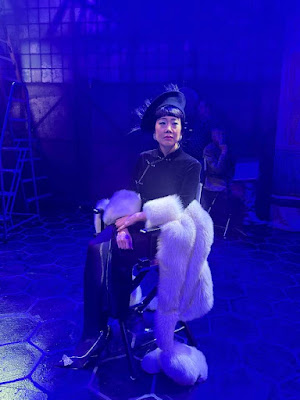
At ACT of CT, an immersive, acclaimed, award-winning Equity-based venue where dare-to-be-dared ideas, theories and conceits are seamlessly mixed with creative concepts, design elements and staging choices that are propulsive, harmonious and think-outside-the-box a freshness, the story and music of "Sunset Boulevard" is primed and ready for its closeup with comeback vehicle splendor, fiery anticipation, cleverly shaped persona and hit by a spotlight delusion and grandeur.
Delivered with intimate enhancement, creamy command, dead-eyed cynicism and high standard resolve, ACT of CT's deep dive glide into the anguish, beauty and torment of this classic Hollywood tale is truly magnificent. It is an attractive, powerful piece of musical theatre 
voiced with affirming mystery, playful abandon, rooted film noir, blunt attitude and grandiose narrative storytelling.
Executing all the right moves, marks, dashes and punctuations, it dazzles with spotlight persuasion, effort, and undeniably theatrical size, scope and exhilaration.
It is ambitious and full-hearted.
It is tight and old-fashioned.
It is snarky and acidic.
It is connective and edgy.
It is dark and dizzying.
It is Hollywood classic lost in a world of intertwined glamour, pathos and wonderment.
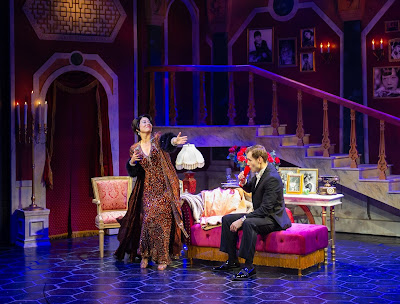
To give "Sunset Boulevard" the stand-out darkness and romanticism it needs to reach its quickfire high note, director Daniel C. Levine jumps right in and pens a unified, stunning film noir close up of reinvention, surprise, edge and Hollywood glamour with directorial choices so polished and attesting, the musical's clash between reality and fantasy explodes with first-time thrill-and-spill, twisty aspiration and exalted, hypnotized technique. As storyteller and artist, Levine is clearly in his element here and his collective grasp of the material, its tremendous sense of theatricality, its melodrama and its ripened colors and motifs befit his impassioned, ravishing storytelling.
Upon entering the venue's spacious, immersive playing space, the theatergoer finds the show's title colorfully emblazoned on a widescreen front curtain, which, through Levine's eyes, immediately prompts questions about the action that will soon unfold once the house lights dim, the overture is played, and the "Sunset Boulevard" story hits its mark.
Is this revival, arthouse cinema? Is it film noir homage? Is it 1950's theatre moved forward in time with real vintage Technicolor flair and flourish? Are, we, the audience, witness to downstage, voyeuristic intimacy steeped in silent movie expressionism and magic? 
The answer, of course, is "Yes."
Well versed in the irony, bite and plot machinations of the original 1950 Billy Wilder screen version and the lush musicality of Webber's original stage adaptation, Levine, a visionary in his own right, puts his own directorial spin on this production, bringing new ideas and knowledge to the work using striking, simplified takes, pauses, beats and rhythms to create a cinematic, beguiling, one-on-one trajectory between actor and audience, conditioned with real thought, real drama, real purpose, inevitable edge and film noirish confrontation.
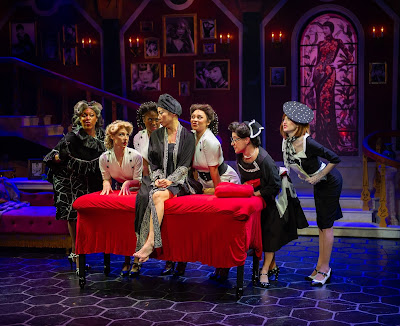
Directorially, Levine dances to his own decided beat and rightly so. Here, as in "Evita," "Jesus Christ Superstar" and Working," he is a true original. He's not interested in paint-by-numbers musical theatre. He's not one to play by the rules. He isn't going to let his audience down by page-by-page directorial copycatting or standard blueprint interpretation. Instead, he grabs his paintbrush and experiments. He takes chances. He rattles and roars. He interprets to cite strong reactions. He creates with buzz and devoted illustration. 
What's remarkable about his take on "Sunset Boulevard" is the amount of attention Levine pays to detail. The movement of a prop, a kiss between Joe and Norma, a grimace, a widescreen shot or a hold is just as important to the storytelling as is the positioning of a silent film camera, a spotlight, a director's chair bearing the Paramount Studios logo, a walk through the studio backlot or the opening of a traveler curtain that reveals the Desmond palazzo featuring strategically placed black and white photos of the actress herself on the back wall, similar in style to those of silent screen movie star Anna Mae Wong, Hollywood's first Chinese-American star.

And that's only the beginning.
During the first act of "Sunset," Levine begins the pending seduction between silent screen star and penniless writer with a brilliant bit of staging that finds Desmond slowing unwrapping her "Salome" screenplay (she is hoping for "a return" to motion pictures) with a long red ribbon which she uses to entrap and ensnare Gillis by tying it up casually between his unsuspecting fingers. It's a hint of what will happen and one that Levine thrusts forward with an obvious sensuality and tension that heightens the brewing and eventual "toy boy" romance between the couple.
Given the musical's homage to the silent screen era, Levine, when necessary, adapts a clever, cinematic directorial style that is purposely played out with the exaggeration and melodramatic staginess of a D.W. Griffith 1915 movie epic. Most notable is Desmond's retreat to her glory days which has the character step forward into a flickering white light reenacting moments from one of her silent movies. It's an eerie, effective, mind-blowing process that immediately recalls Alla Nazimova's overacting in the 1921 film version of "Camille" and Lillian Gish's subsequent exaggeration in "The Birth of a Nation," circa 1915. A brilliant touch of madness, on Levine's part. Simply brilliant.
Elsewhere, Levine's melodramatic use of a gorgeous backwall stained glass window bearing a full-length image of Desmond herself is effectively played out with a special flashing-light madness (when needed, of course) that heightens the dramatic momentum of the piece as does a stop-and-go staging technique of red-and-white illusion that portrays the death of Gillis by Desmond's hand (i.e., revolver) during the final moments of the musical. 
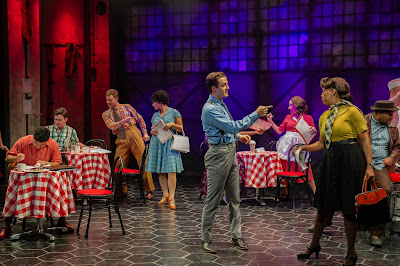

Set to music, "Sunset Boulevard" plays out its boldest prospects and achievements.
Its wavering, sometimes feverish themes of illusion, triumph, escape and film noir come full circle in the excitingly realized original musical score which bears the familiar Andrew Lloyd Webber creative stamp (he composed the music) and that of his collaborators Christopher Hampton and Don Black (they wrote the lyrics).
Filled with an engrossing mix of ballads, solos, duets, ensemble turns and cinematic anthems, the songs, all centered, positioned and primed, are, in order of performance:  "Overture," "Let Me Take You Back Six Months," "Let's Have Lunch," "Every Movie's a Circus," "Surrender," "With One Look," "Salome," "The Greatest Star of All," "Every Movie's a Circus (reprise)," "Girl Meets Boy," "New Ways to Dream," "The Lady's Paying," "The Perfect Year," "This Time Next Year," "Entr'acte," "Sunset Boulevard," "There's Been a Call," "As If We Never Said Goodbye," "Surrender (reprise)," "Girl Meets Boy (reprise)," "Eternal Youth Is Worth a Little Suffering," "Too Much in Love to Care," "New Ways to Dream (reprise)" and "The Final Scene."
Webber's flair for the dramatic - via music, song style, progression and orchestration - works wonders here as he pays tribute to the original Billy Wilder 1950 motion picture, its theatrics, its subject matter, its irony, its darkness and its Oscar-winning score by Franz Waxman.  It's pointed. It's set. It's determined. It's creative. It's sweeping. It's engaging. It's tango. It's jazz. It's showtune iconic. It speaks volumes.
More importantly, his compositions smartly reflect the buzz and snare of the movie industry, its backlot players, its forgotten stars, its entrapment, its cynicism, its power plays, its struggles, its delusions, its hypocrisy and its dream of, one day, making it big on the silver screen. Hampton and Black, in turn, strike back with choice, motivated lyrics that recall the acidity, the angst, the melancholy, the bite and the acknowledgement of the silent film era and the black-and-white movie.

With credits that include musical direction for the Broadway staging's of "Wicked," "Jagged Little Pill," "Chaplin," "Almost Famous" and the National Touring company of "Next to Normal," Bryan Perri is the perfect choice to bring "Sunset Boulevard" front and center at ACT of CT.
He's talented. He's centered. He's direct. He's inventive. He's focused. He's challenged. He makes beautiful music.
Here, as both musical director and conductor, he 
addresses the thrilling, monumental Webber/Black/Hampton score with wit, imagination and propulsion, thus, capturing the darkness, the romanticism, the melodrama and the moodiness of the piece, coupled with well-orchestrated bits of silent screen nostalgia, flickering eccentricity and quickfire snap, encouragement and attitude. It's a task he takes to heart with much-loved innovation, illumination, intensity, pride and evident enjoyment. 
With Perri at the helm, the trio's musical language and its unique combination of words and music also comes full circle with effective, game-changing orchestral sophistication and brilliance. It's all savored and managed with luminous directness, interpretive specificity and Broadway musical rapture and enticement.
For this production, Perri (keyboard one) has assembled first-rate team of talented and dedicated musicians to bring the "Sunset Boulevard" score to life at ACT. They are Kai Hedin (viola), Jeff Cox (keyboard two), Seray Goktekin (violin), Cheryl Labrecque (cello), Gary Blu (reed one), Sue Goff (reed two), Darcy Macrae (drums/percussion), Ronald Hartner (trumpet/flugelhorn), Marjorie Callaghan (french horn), Kevin Callaghan (bass) and Dennis J. Arcano (synthesizer programmer). Vital, vigorous and attentive, this orchestral ensemble display a sterling sound and style that brings exhilarating highs to the musical score, its interpretive balance, its tonal challenges, its ripened qualities and its registrational grouping of musical numbers.
It's a distinct, ripe, collaborative effort, filled with the right touches and the right flourishes of sound, irony, string and functioning color. It is also flavorfully sprinkled with shimmering timbers, melodic waves, sumptuous movements and dashes of uplifting experimentation and ideas that complement the tone, the passion, the commitment and the evolution of the "Sunset Boulevard" story.
In terms of sound, power, expression, execution and orchestral instrumentation, this production far surpasses that of the original Broadway production and subsequent National Tour. Musically, it's Perri's show and one that portrays his great love of musical theatre, its melancholy flow, its construction, its dynamics and how as an art form, music is shaped, played and executed night after night to radiant, beguiling, roof-raising effect before a live audience. 
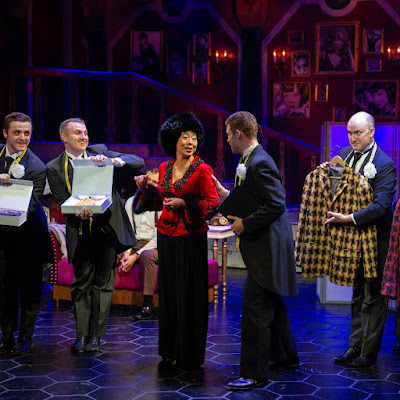
No musical would be complete without its share of production numbers and with "Sunset Boulevard" choreographer Sara Brians enlivens the two-act musical with movements, tableaus and aesthetic refinement that give a fresh feel to the proceedings, marked by instinctive dance strokes that are intoxicating and full of detail, color and narrative expressions. Like Levine, she portrays the production's vintage 1950's setting, stylization and mindset with the exactness of a period Broadway musical, an MGM Technicolor backlot production and a big widescreen weekend movie show layered with strong, on-stage chemistry, light and lyrical sweetness, pop culture precision and sweep and swoon volume and musicality. In turn, "Let's Have Lunch," "Every Movie's a Circus" and the show-stopping "The Lady's Paying" (the "Sunset" ensemble is absolutely incredible) glide across the stage with vivid, mindful signature purpose and absolutely no modernization (a Levine touch, as well) whatsoever. It's as though Brians time traveled back to the 1950's and returned with shot-for-shot theatricality, tilting reproduction and real, authentic cinematic confection. 
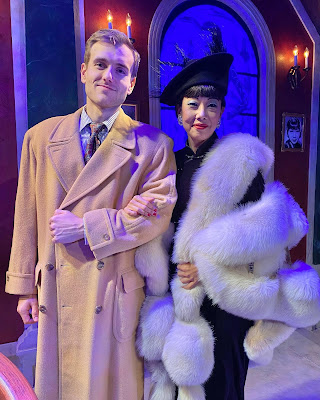
For the London production of "Sunset Boulevard," currently playing at the Savoy Theatre, director Jamie Lloyd chose to make the character of Norma Desmond (played magnificently by Nicole Scherzinger in the West End revival) younger than she was portrayed by Gloria Swanson in the 1950 film and the garish-looking, overwrought and spooky Glenn Glose in the original 1994 Broadway musical. It's a creative choice that is masterstroke worthy and one that Levine, for his ACT of CT directorial turn, also fulfills with equal opportunity and star status bravura with the casting of Asian-American star Pearl Sun as the delusional, tormented, glamourous Norma Desmond.
Sun is not only ready for her close up but delivers a powerhouse performance of glitter, intrigue and vulnerability like no other.
In the role of a faded movie star looking to reclaim her former glory as a box-office icon, Sun infuses the part of Norma Desmond with real glamour, madness, desperation and fantasy world entrapment.
She is silent screen goddess jilted by Hollywood industry abandonment. She is museum and mausoleum taunted. She is lush, romantic and melancholic. She is film noir greatness with dashes of Anna Mae Wong, Alla Nazimova, Pola Negri and Theda Bara. She is eccentric, abrasive and cunning. She is privileged and grand. In extreme close-up, her hands, her body and her eyes flicker with silent-screen magic.

Sun's brilliant assumption of the role, molded with confidence, rapture, encore and invitation, is ignited with affecting acumen, range, accuracy and vintage bravura. It's eye-catching revolutionary - defying gravity, if you prefer - but at the same time, very much, original, committed, stand-alone focused, vital and bewitching.
Vocally, she tears into the Webber/Black/Hampton score with raw, reflective escape, powerful lift, elbowing and tone, gracious imagination and leading lady warmth, radiance and sensation. Singing such iconic showstoppers as "With One Look," "As If We Never Said Goodbye," "Surrender" and "The Perfect Year," Sun is very much in her element, channeling the inspiration, drama, variety and note-perfect brilliance of the "Sunset Boulevard" musical score to perfection. But she's no copycat. She's an original.
When she steps downstage center to perform the second half of the silent movie drenched remembrance "As If We Never Said Goodbye" with stand-out capture, the actual number, as staged by Levine, not only magically seduces the theatergoer, but the on-stage ensemble as well, all of whom slowing turn, bask and succumb to the beauty of Sun's solo, its intertwined fantasy, its triumphant grandeur and its lyrical brilliance.
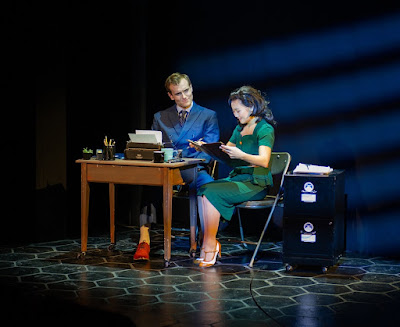

Michael Burrell, cast in the role of Joe Gillis, the drifting opportunist and fledging Hollywood writer who allows himself to be kept by Norma Desmond, invests the part with the dash, charm, curiosity, good looks and tangled entrapment envisioned by the musical's original collaborators. It's a performance of boulevard acknowledgement and Hollywood dazzle and dream mixed with proper confidence, irony, swagger and homage-spirited influence.
His many vocals - "Let Me Take You Back Six Weeks," "Sunset Boulevard," "Too Much in Love to Care," "Let's Have Lunch," "Girl Meets Boy"- are delivered not only with the crisp, powerful truism and flair reflective of his strong, natural hold on the musical elements of the piece, but with the wit, sarcasm and expression concurrent in the sweeping score, its suave, tart lyrics and the vitality of the proceedings.

As sweet-voiced, anxious Betty Schaefer, Helen J. Shen inhabits the role (she plays Gillis' attractive, aspiring writing partner) with a certain charm, zest, personality and clarity that not only defines her important position in the musical narrative but gives it a strongness and confidence that is put to great use whenever she's on stage, most notably in her many scenes with Michael Burrell, her charismatic co-star. Vocally, she possesses an amazing voice, style and range that is wonderfully refreshing, engaging and chock full of emotional certainty. Listening to her perform the beguiling, showstopping duet "Too Much in Love to Care" alongside Burrell halfway through Act II furthers that notion. Both performers build this song to such stirring, romantic effect, a replay would be most welcomed.

George Xavier, as Max Von Mayerling, Norma Desmond's former director and ex-husband, now dutifully positioned as the silent screen film star's trusty manservant and fierce protector, crafts a masterful, haunting portrait of a silent screen auteur and survivor, mixed with the darkness and delusion of the character as portrayed in both the Billy Wilder movie and the original Broadway production. He is both captivating, majestic and achingly sincere. Vocally, his rich bass-baritone range is seasoned ready, intersected with wonderful clarity of pitch, tone and dynamic control, most notable when he performs Mayering's hypnotic solo "The Greatest Star of All" in Act II and the emotionally riveting reprise of "New Ways to Dream" in Act II.

As evidenced in previous ACT of CT productions - "Evita," "Working," "Nickel Mines," "Little Shop of Horrors," "Jesus Christ Superstar," among others, - the design element is an important point of every presentation. Here, the creative team of David Goldstein (scenic designer), Charlie Morrison (lighting designer), Kurt Alger (costume and wig designer), Marisa J. Barnes (sound designer), Angelina Avallone (makeup designer) and Daniel C. Levine (projection designer) work together, using talents, ideas, experimentation and backstage savvy to create a "Sunset Boulevard" stomping ground rich in color, atmosphere, nostalgia and character. It's a focused camaraderie with tech and visuals rooted firmly in the past world of yesterday that bring the theatergoer closer to the world of both Billy Wilder and Andrew Lloyd Webber.

Ensemble wise, "Sunset Boulevard" overflows with a dream cast of actors, singers and dancers, some of whom have graced the ACT of CT stage before or are making their official ACT debut with this production. All of them - Emily Solo, Amanda Hunter-Finch, Gary Harger, Val Moranto, Liz Schmitz, Andrew Winans, Will Stone, Mac Myles, Conor McGiffin, Daniel Pahl, Claire Fossey, Pragun Bhardwaj, William Bishop, Jasmine Gobourne - are well-suited for each of the particular roles they are asked to portray throughout the two-act musical, each akin to Levine and Brian's 1950's mindset, the musical's vintage pairings, groupings, staging and stylization, its choreography, its songs, its harmonies, its film noir homage, its Hollywood grandeur, its plotting, its evolution and its emotional denouement.
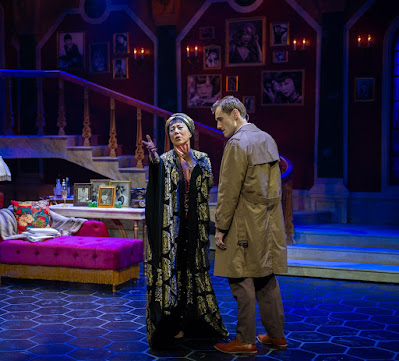
A mind-blowing triumph for director Daniel Levine, his cast and his creative team, this hypnotic portrayal of "Sunset Boulevard" sets the ACT of CT stage ablaze with groundbreaking intensity and glory, backed by a thrilling springboard of vamp, memory, illusion, embrace and caring, total artistic achievement.
Recharged with an honest, affecting intimacy and an intimate 1950's film classic dramatic stylization that leaves a long, lasting impression, it bristles with such dare and avant-garde sensation, it demands to be seen not once, but twice, without question.
Its fearless gaze into the forgotten Hollywood of yesteryear is both haunting and swaying as is its properly balanced turntable of story, music, song, action and character.
As seen through the directorial lens of Levine and musical showman Bryan Perri, it tilts, its spins, it haunts, it teases, it marvels, and it surprises.
This is musical theatre at its best, primed and etched to perfection, basking in the chilling, truth-bending sweep set forth by its London-based originators, its leading ladies, its glossy storytelling devices and its whip smart, film noir magnificence.
In Norma Desmond's eyes, "it's the pictures that got small."
And, maybe, that is true.
But here, at ACT of CT, "Sunset Boulevard" is alive with endless possibility, delivery, captivation and unmistakable shatter, force, doom and gloom. It's also more than just one woman's descent into extreme close-up madness as the music builds to a crescendo, the character of Norma Desmond faces her tormented fate the stage lights fade to black. 
This is go-for-broke "Sunset Boulevard" with a numbing, gratifying big finish.

Photos of "Sunset Boulevard" courtesy of Jeff Butchen.

"Sunset Boulevard" is being staged at ACT of CT (39 Old Quarry Road, Ridgefield, CT), now through November 19, 2023.
For tickets or more information, call (475) 215-5497
website: actofct.org


Sunday, October 29, 2023

From the Desk of Jim R, Take 2, Column 434, A Concert Review: "First Lady of Song Cherise Coaches Sings Ella Fitzgerald" (Westport Country Playhouse)

By James V. Ruocco

The voice.
The sound.
The range.
The power.
The songs.
The life. 
The career.

Ella Fitzgerald - the first lady of song - is given the all-star treatment in Westport Country Playhouse's jazzy concert tribute "First Lady of Song Cherise Coaches Sings Ella Fitzgerald," a fond, tuneful and lively trip down memory lane that celebrates the life and times of one of the music industry's greatest recording artists with remembrances, songs and conversations from her illustrious half-century career.

An "Artists Lounge Live" production, documented with flair, liberation and triumph, this two-hour concert event, which includes a fifteen-minute intermission, replays and reinvents moments from Fitzgerald's "Great American Songbook" repertoire with clear, careful jazz precision, a probing, nostalgic thoughtfulness and time-honored music that lovingly spills its guts with jazz club, supper club influence and jubilation.

Structured as much by theme, appreciation, dedication and arrangement, this production gets off to an incredible jazzy start (how could it not?) that grows in stature from song to song and moment to moment before its glorious, memorable, exciting big finish.
It also fits perfectly into the intimate, welcoming and cozy environs of the Westport Country Playhouse with smiles, tears and applause deftly etched in from patrons, newcomers, regulars and music lovers united as one to hear songs they've all heard before and want to hear again and again.
Magical, oh yes. 
And, so much more. 

Make no mistake about it: "First Lady of Song Cherise Coaches Sings Ella Fitzgerald" is in a class by itself.
It unfolds with brooding melancholy and bristle.
It is commanding and heavenly.
It tilts and spins.
Its breezy jazz eruption channels the lady herself.
Its balance of color, detail and complexity heightens its charm, its vibrance and its signifying groove, immediacy and trigger.
And then, there is the star herself.

Creating a strong, natural and charismatic bond between singer and audience, Chicago-born actress and entertainer Cherise Coaches takes center stage in "First Lady of Song" and creates a unique sound and vibe of boom, high energy, impact and passion.
She is sensational. 
But first, let's backtrack.
On Broadway, Coaches appeared in the hit musical "Waitress" and later, was featured in the National Touring edition of "Disenchanted: The Musical."
Her other credits include Dionne in "Hair," Charlene in "Dreamgirls" and Young Patti in "A New Attitude: In Tribute to Patti LaBelle." 
With "Artists Lounge Live," Coaches appeared as a featured vocalist in "Aretha Franklin: Queen of Soul," "Higher and Higher with Chester Gregory" and "Signed, Sealed Delivered: John-Mark McGaha Sings Stevie Wonder."

With "First Lady of Song," Coaches shows how passionate she is about the music of Ella Fitzgerald, the songs she chooses to sing in concert, how and why each piece holds a special place in her heart and more importantly, the impact that comes from right after hearing and performing it.
Vocally, she dazzles and shines with a voice and range that showcases her talents in full display, offset by skill, uplift, swing and imagination.
Here, Fitzgerald's song hits - there are many - are remembered with a certain oomph and fondness that makes the occasion in Westport even more special.
They include: "I Got Rhythm," "Misty," "Mack the Knife," "Night and Day," "Summertime," "The Lady is a Tramp," "It Don't Mean a Thing If It Ain't Got That Swing," "A -Tisket, A-Tasket," "My Funny Valentine" and "Too Dark Hot," among others.


Backed by a confident, committed onstage band that includes William Kurk (musical director, piano), Jay Flat (flute/saxophone), Ryan Bennett (drums) and Runere Brooks (upright bass), Coaches steps into the limelight putting her own personal spin on the music of Fitzgerald rather than imitate or copycat the legendary singer's special voice and sound. It's a creative choice that the singer spins with warmth, bewitchment, purity, timelessness and Harlem Savoy Ballroom sultriness. It's all velvety smooth and navigated. Or belted and crooned with powerhouse sensation and bustle.
The singer also engages in scatting, a vocal improvisation that Fitzgerald was famous for, improvising melodies, sounds and rhythms, comprised of nonsense syllables, wordless vocables, humor, quick tongue, various compressions or no words at all. It's a showstopping feat and one of the many, many highlights of this exhilarating production.

Written and directed by Angela Ingersoll, "First Lady of Song" also comes packaged with unique stories, tidbits and facts that recall Fitzgerald's life story from her 1917 birth in Newport News, Virginia to her death at the age of 79 from a stroke in 1996.
With Coaches as narrator, a part she claims with tremendous inspiration and spirit, the audience is privy to lots of valuable documentation that includes Fitzgerald's 1934 "Amateur Night" contest win at Harlem's legendary Apollo Theater, her years of mentoring with bandleader Chick Webb, her first hit single at age 19, her booking at L.A. hotspot Macambo via superfan Marilyn Monroe and the creation of Verve Records in 1955 for the singer herself.

"First Lady of Song Cherise Coaches Sings Ella Fitzgerald" is being staged at Westport Country Playhouse (25 Powers Court, Westport. CT), now through November 5, 2023.
For tickets or more information, call (203)227-4177
website: westportplayhouse.org

Tuesday, October 24, 2023

From the Desk of Jim R, Take 2, Column 433, A Review: "Pride and Prejudice" (Hartford Stage)

By James V. Ruocco

There are many ways to stage novelist Jane Austen's cherished 1813 novel of manners "Pride and Prejudice" without losing the richness of her writing, her carefully choreographed plot and her hugely entertaining views of the world, society, wealth, influence, marriage, courtship, position, alliteration, observation and the complete absurdity of it all.
In Hartford Stage's animated, brilliantly skewered interpretation of Austen's classic character study, playwright Kate Hamill digs deep into the novel's very posh, readable text and concocts a tale of great comic relief that pushes the boundaries of manners, marriage, social standing, education and morality in the most entertaining of ways. It's still the same story, but it's crafted without the stiff, upper lip dramatics and theories of a four-part BBC presentation, a prim and proper National Theatre revival or a sprawling cinematic adaptation from the popular heyday of the Merchant-Ivory filmmaking team.
Through the bold, outrageous comedic lens of Hamill, this glorious Austenian take on "Pride and Prejudice" is a treatment like no other. It revives the original source material with such with thrill and spill, one easily succumbs to the page-turning craziness and versatility of the presentation itself, its critique of feminism and social conventions, its playful conversations and banter and its over-the-top theatrics and acknowledgements that propel the action forward with steadfast giddyap.

Played against the backdrop of Sara Brown's lush, atmospheric set design, which includes a twirling, revolving stage of early 19th century period surroundings, this frame-worthy, nontraditional take of Jane Austen - reinforced by a joyride of gleefully oddball jokes, ideas, scandals, proposals and cross-casting outrageousness - is so much fun, one wishes there was a "replay" button to watch it all over again.

Better yet, this "Pride and Prejudice" dances to its own set of rules.
It is saucy and irreverent.
It is jaunty and peculiar.
It is confident and spirited.
It is grand and glorious.
Its screwball silliness is masked with chiming cynicism.

Set in rural England, circa 1813, the play centers on the themes and conflicts of the day when women either married for love or for purely economic reasons. For plot purposes, because none of Mr. Bennet's four daughters - Lizzy, Mary, Jane or Lydia - can inherit his Hertfordshire estate (in the novel and the 1940 film adaptation starring Greer Garson, there are five daughters) they are pressured by both he and Mrs. Bennet to marry well and find financial security in what is commonly known as "good marriages."
And so, the game begins.
Who is suitable? Who is not?
Who has money? Who has prospects?
Who can help secure the Bennett family fortune?
Which man - there are many - will bewitch the Bennett sisters?
And who, during the final fadeout, will get their happily ever after? 


At Hartford Stage, "Pride and Prejudice" is being staged by Tatyana-Marie Carlo whose directorial credits include "Marisol," "She Kills Monsters," "The Last Days of Judas Iscariot," "Clybourne Park," "Real Women Have Curves" and "Don Quixote." It's a labor of love fueled by smart directorial choices, great comic zing and snap, well played, collective gimmickry and push and pull silliness.
In shaping Hamill's inventive playscript, she creates a lively, circus-like arena where private conversations, upper class exchanges, chance meetings, exits, entrances, philosophies, theories, dispositions and playful romantic notions are tossed and bandied about with giddy, front-and-center abandonment.
At the same time, nothing is out of place, thrown in or shockingly tactless. As "Pride and Prejudice" evolves, Carlo adapts a vigorous, refreshing and mischievous gait that is confident, inventive, apparent, surprising and knee-deep in Panto-like creativity, assertiveness and period melodrama.
Here, timing is everything and Carlo balances humor, pathos and wit with dynamic, well-oiled flashes, flourishes, sweeping, sloping, prancing, preening and expansive gestures that complement the merriment and drawing room theatrics at hand. It's all very genuine, unexpectedly funny stuff that lives up to its potential and tears into the 1813 source material of Austen's legacy with a voice that is confident, snarky, devious, enlightening and whimsical. Directorially, she also marshals her eight-member cast swiftly and expertly through the play's fast-paced scene changes, fadeouts, musical interludes and dances with splendid musicality.
This is timeless, universal, thoroughly engaged Austen played mainly for laughs, coasting effortlessly between Hertfordshire, Netherfield, Kent and Pemberly, then back again.

That's not all. Glitter balls and disco-like dances spring out of nowhere. Modernism is mixed amusingly with Regency wanderlust. Sight gags pop up with in-and-out craziness. Characters run wildly across the stage screaming, ranting and raving. A purposely paused Hertfordshire location gets a Hartford, Connecticut name drop giggle. Certain lines are purposely exaggerated as if "Pride and Prejudice" was reborn as a late 19th century melodrama. Period fans are opened and closed by the female characters with very loud flaps and flapping. The fourth wall is continually broken to allow certain characters to flirt with the audience or enter and exit through the actual theater. Spilled punch prompts rowdy crotch jokes.
The use of a mannequin, garbed in period servant's clothing, to announce the arrival of certain characters, is well worth the price of admission as is the hilarious substitution of broomsticks and poles (all dressed in various, familiar costume fragments) whenever an actor is playing a different role, but their previous character, is called upon, if only fleetingly to participate in the ongoing scene. A true stroke of genius on Carlo's part.

"Pride and Prejudice" stars Renata Eastlick as Lizzy, Carman Lacivita as Mr. Darcy, Lana Young as Mrs. Bennett, Anne Scurria as Mr. Bennett and Charlotte Lucas, Madeleine Barker as Mary and Miss Bingley, Sergio Mauritz Ang as Mr. Bingley, Wickham and Mr. Collins, Zoë Kim as Lydia and Lady Catherine and María Gabriela González as Jane and Miss de Borough.
Everyone in the cast are tremendously gifted, talented performers whose charm, warmth, wit and knack for this type of full-tilt mayhem and craziness give the production its unifying lift, pulse, drive and fever-pitched adrenaline. Under Carlo's intuitive, fancy-free, colorful direction, each and every actor inhabits the role he or she is given (Barker as the unhinged Mary is a real comic standout) with the right comic dash and flourish that serves the material well. Everyone understands his or her role inside out and all around. They are quick on their feet. They know how to play comedy and they play it well. They engage. They entertain. They toss and turn. They give the play's multiple characterization and cross-casting conceit the creative aplomb it deserves. They have great onstage chemistry with one another. They know how to get a laugh without exposing the punchline. They can also shift gears in a millisecond whenever they are asked to change from character to character, man to woman, or vice versa.

Silly, lightweight, witty, romantic and swayable, Hartford Stage's sumptuous mounting of "Pride and Prejudice" breathes new life into Jane Austen's celebrated 19th century classic. It gallops and stirs. It tilts and glides. It delights and cajoles. It takes liberties with the actual story and gets away with it.
Playwright Kate Hamill creates a madhouse of giddy romantic mayhem, entanglement and enticement. Director Tatyana-Marie Carlo goes full-tilt in well-timed, harmonious fashion. Regency period costuming designed by Haydee Zelideth makes its mark in true couture fashion.
The entire cast has great fun with the insanely wacky material. And like several other Hartford Stage productions that came before it - "The Rivals," "Loot," "The School for Scandal," "Tartuffe," to name a few - every element works splendidly in this liberating, intoxicating staging that amusingly conveys the age-old struggle between pride and prejudice with riotous exhilaration, social mayhem, screwball indulgence and gooseberry empowerment.
In short, what's not to love?

Photos of "Pride and Prejudice" courtesy of T. Charles Erickson

"Pride and Prejudice" is being presented at Hartford Stage (50 Church St., Harford, CT), now through November 5, 2023.
For tickets or more information, call (860) 527-5151.
website: hartfordstage.org